

Turning a Stock Price Drop Into Provable Damages
Key Takeaways: Federal securities law does not compensate investors for every stock decline, only for losses tied to the revelation of fraud. A corrective disclosure reveals that prior statements were false, and a forensic event study is the statistical tool commonly used to show the drop was caused by that revelation rather than market or industry forces. The economist models the stock’s expected return, compares it to the actual return, and tests whether the abnormal return is statistically significant. Under Dura Pharmaceuticals and 15 U.S.C. § 78u-4(b)(4), plaintiffs generally carry the burden of proving loss causation, and courts may scrutinize expert methodology under Rule 702. One contested issue is confounding news, where same-day announcements make it hard to isolate the fraud-specific price impact. If causation is shown, per-share inflation may inform damages, subject to the 90-day look-back limitation and strict filing deadlines.
When a company admits the truth and its share price falls, investors ask how much of that loss was caused by the fraud. Federal securities law generally does not allow recovery for every decline in a portfolio. Instead, it requires proof that the specific truth-revealing announcement caused the drop, and that proof often arrives in the form of a forensic event study prepared by an economist. In a corrective disclosure securities class action, this analysis can play a significant role in whether a case survives, settles, or fails.
If you purchased shares before a damaging disclosure and watched your investment fall, the team at Kaskela Law can review the timeline and explain your options. Call 484-229-0750 or contact us now to discuss a potential claim at no obligation to you.
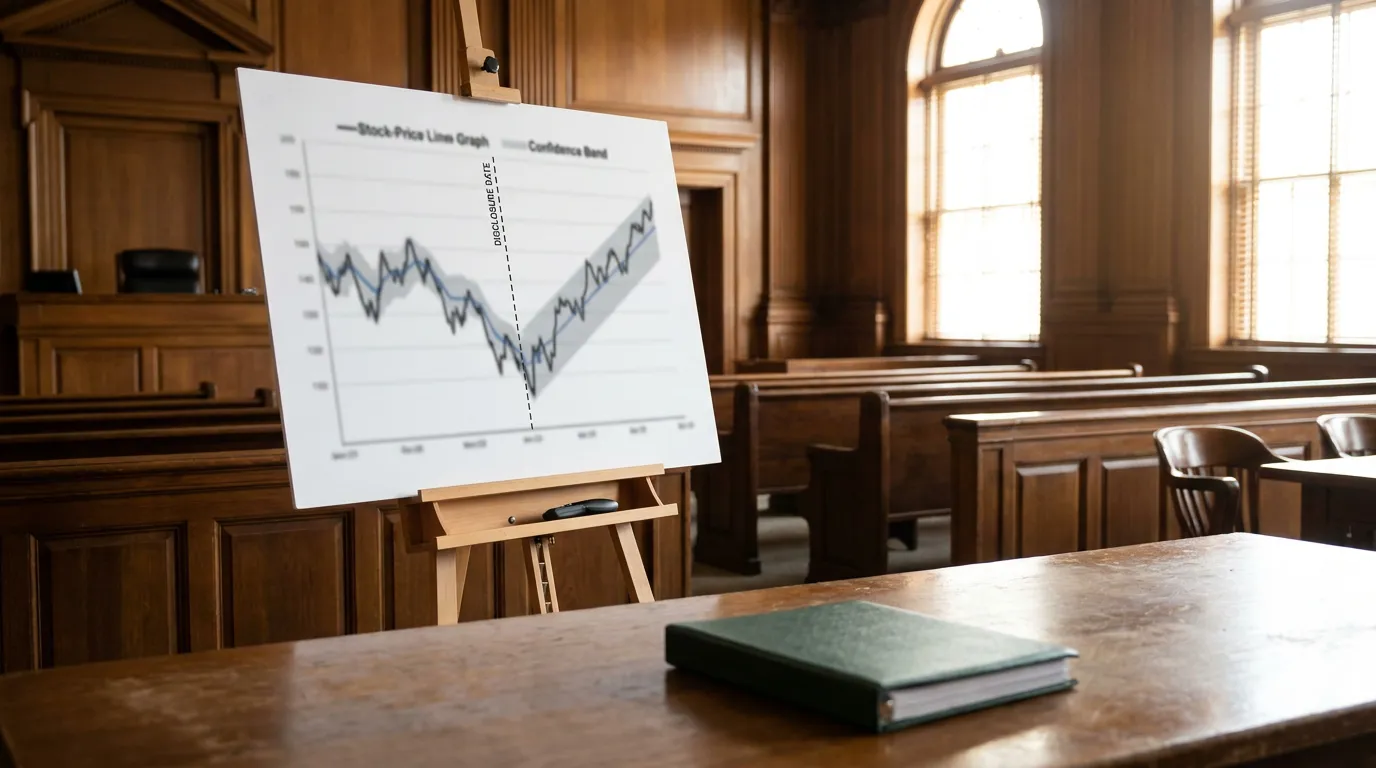
What a Corrective Disclosure Actually Is
A corrective disclosure is the moment the market learns that prior public statements were false or misleading. It may take the form of a restatement, a surprise regulatory action, a short-seller report, an executive resignation tied to accounting problems, or a delayed filing notice. Whether any particular event qualifies is decided case by case, and courts generally look at whether the announcement revealed the concealed truth, not merely whether bad news appeared.
Timing matters enormously. The disclosure typically marks the end of the class period, the window during which investors allegedly purchased at artificially inflated prices. Investors who bought during that window and held through the disclosure may have recoverable losses, though recovery depends on purchase and sale dates, proof of the claim, and litigation outcome.
Why Bad News Alone Is Not Enough
Not every negative announcement qualifies as corrective. A company can miss earnings, lose a customer, or face an industry downturn without revealing any fraud. Under Dura Pharmaceuticals, Inc. v. Broudo, 544 U.S. 336 (2005), plaintiffs generally must prove the loss resulted from the truth becoming known, rather than from changed economic circumstances or investor expectations alone. Courts often scrutinize whether the announcement connected to the alleged misrepresentation, and some have accepted that the truth may emerge other than through a formal corrective announcement, including a materialization of the concealed risk.
The Mechanics of a Forensic Event Study
An event study is a statistical technique used to measure the impact of a specific event on a security’s value. The economist builds a model of how the stock would ordinarily move given market and industry conditions, then compares that prediction against what actually happened on the disclosure date. The gap between the two is the analytical heart of the exercise.
That gap is called the abnormal return, the actual return minus the return predicted by an expected-return model, such as the market model or the capital asset pricing model. Investopedia’s overview of event study methodology describes the same approach: measuring returns around an event date to isolate the effect attributable to that event.
A typical analysis may proceed through several steps:
- Defining the event window, often a single trading day or short multi-day period around the disclosure
- Estimating a regression model using returns from a comparison period unaffected by the alleged fraud
- Calculating the predicted return using market and industry index movements
- Subtracting the predicted return from the actual return to derive the abnormal return
- Testing whether that residual is statistically significant rather than ordinary trading noise
💡 Pro Tip: Preserve your brokerage confirmations and monthly statements as soon as you suspect a problem. Damages models depend on exact transaction dates and prices, and reconstructing them years later is far harder than saving them now.
Proving Loss Causation in a Corrective Disclosure Securities Class Action
Loss causation is the legal bridge between the misstatement and the investor’s economic harm. Section 21D(b)(4), codified at 15 U.S.C. § 78u-4(b)(4), generally places on the plaintiff the burden of proving that the alleged act or omission caused the loss. Event studies are commonly used because that burden is often addressed quantitatively, not merely narratively, although no statute requires one.
Courts have not adopted a single rigid formula. A statistically significant negative abnormal return on the disclosure date may support an inference of causation, while an insignificant result can invite dismissal or summary judgment arguments. Courts have also noted that loss causation is generally not resolved at the pleading stage and is not a prerequisite to class certification, and reasonable economists sometimes reach different conclusions using different windows or benchmark indices.
How Courts Treat Expert Economic Testimony
Judges generally act as gatekeepers for methodology, rather than as arbiters of which economist is more persuasive. Federal Rule of Evidence 702 requires that expert testimony rest on sufficient facts, reliable principles and methods, and a reliable application of those principles to the facts. A securities fraud ruling from the District of New Jersey, available through the federal securities fraud docket on Justia, reflects the ordinary posture in which courts evaluate stock price reaction evidence at the pleading and class stages.
Third Circuit authority may carry particular weight for investors near Newton Square. Because the Eastern District of Pennsylvania and the District of New Jersey both sit within the Third Circuit, loss causation standards developed in one district may inform litigation in the other, although district court decisions are persuasive rather than binding.
The Confounding News Problem
One of the hardest challenges in any stock price decline analysis is separating the corrective information from everything else announced the same day. Companies rarely disclose fraud in isolation. A restatement may appear alongside disappointing guidance, a dividend cut, or a leadership change, and each item may independently move the price.
Academic commentary has pressed this point forcefully. Scholarship examining the limits of event studies in securities fraud litigation argues that courts sometimes overestimate how precisely the technique can isolate fraud-specific causation, particularly when market efficiency assumptions are strained or the "corrective" component is embedded in a broader negative announcement.
Economists also debate what counts as genuine news. If the market had already partially anticipated the revelation through rumors, analyst reports, or short-seller commentary, the measured price reaction on the official disclosure date may understate the true inflation. Careful analysts examine surrounding days to determine whether information reached the market in advance.
| Analytical Issue | Plaintiff Position | Common Defense Response |
|---|---|---|
| Same-day negative news | Fraud revelation drove the drop | Confounding news explains the decline |
| Multi-day windows | Information absorbed gradually | Window was manipulated to capture unrelated moves |
| Partial disclosures | Truth emerged in stages | No single event revealed the fraud |
| Benchmark selection | Industry index isolates firm-specific loss | Alternative index eliminates significance |
Building the Damages Model
If causation is established, the analysis generally shifts to measuring per-share inflation across the class period. Economists estimate how much artificial inflation existed on each trading day, then apply that figure to class members’ transactions. The result can inform aggregate damages estimates and often frames settlement negotiations, though the ultimate measure is determined by the court or through settlement.
Damages may also be constrained by statute. Under 15 U.S.C. § 78u-4(e), recovery is generally capped at the difference between the purchase price paid and the mean trading price during the 90-day period beginning on the date the corrective information is disseminated, commonly called the bounce-back rule. For shares sold during that window, the statute substitutes the mean trading price through the date of sale. This can meaningfully reduce recoverable amounts when a stock rebounds quickly.
What Investors Should Do After a Disclosure
Act deliberately rather than hastily. Investors often benefit from understanding the procedural framework before making decisions, and reviewing how securities class actions work is a useful starting point. Deadlines for seeking lead plaintiff appointment are short and set by statute, so delay can limit options.
💡 Pro Tip: The lead plaintiff motion deadline under 15 U.S.C. § 78u-4(a)(3) generally runs 60 days from publication of the statutory notice of the first-filed complaint. Missing it does not by itself forfeit your ability to recover as an absent class member if a class is certified, but it generally closes the door on seeking appointment as lead plaintiff.
Timing Limits That Investors Should Not Overlook
Federal securities fraud claims are subject to strict filing deadlines. Under 28 U.S.C. § 1658(b), private claims involving fraud under the securities laws must generally be brought within two years after discovery of the facts constituting the violation and no more than five years after the violation. Courts have held that the two-year period runs from when a reasonably diligent plaintiff would have discovered the facts, including scienter, while the five-year period generally operates as a repose period rarely subject to tolling.
These deadlines are generally distinct from any regulatory process. An SEC investigation typically proceeds separately from a private civil action and generally does not by itself extend a private claimant’s time to sue, though the filing of a class action may toll the limitations period for absent class members in some circumstances.
Frequently Asked Questions
1. Does a large stock price drop automatically prove my losses are recoverable?
No. The decline generally must be causally linked to the revelation of the alleged fraud rather than to market conditions or unrelated company news. A forensic event study is one common way that link is tested statistically.
2. What if the company announced several things on the same day?
That situation is common and is known as the confounding news problem. Economists may attempt to disaggregate the effects using analyst commentary, intraday pricing, and related announcements, though outcomes vary.
3. Do I have to hire my own economist to participate?
Generally no. In a certified class action, lead plaintiff’s counsel typically retains the economic professionals, and absent class members often participate through the claims process without retaining anyone individually.
4. What happens if the fraud was revealed gradually instead of all at once?
Some courts have recognized partial disclosure theories, in which inflation may dissipate across multiple events. Proving this pattern can be more complex, and the strength of the claim depends on how clearly each event connects to the alleged misrepresentation.
5. Does it matter that I live in Pennsylvania but the company is elsewhere?
Usually not. Federal securities class actions are generally filed in federal court, and class membership typically depends on when you purchased the security rather than where you reside.
Where the Numbers Meet the Law
Forensic event studies sit at the intersection of finance and doctrine, translating a day of trading into evidence a federal judge can evaluate. The methodology has genuine analytical power, but also documented limitations involving market efficiency assumptions, window selection, and same-day information. Investors who understand both the strength and the boundaries of this technique may be better positioned to evaluate whether a claim is worth pursuing. Outcomes always depend on the specific facts, the governing precedent, and the quality of the underlying economic analysis. Reviewing a firm’s featured securities cases can offer helpful context on how these matters develop.
If you sustained investment losses following a corporate disclosure, the attorneys at Kaskela Law are available to evaluate your situation and explain what deadlines may apply. Reach the firm at 484-229-0750 or schedule a case review today.
Disclaimer: This content is for informational purposes only and is not legal advice. Every case is unique, and results may vary. Past results do not guarantee a similar outcome. Consult an attorney about your specific circumstances.